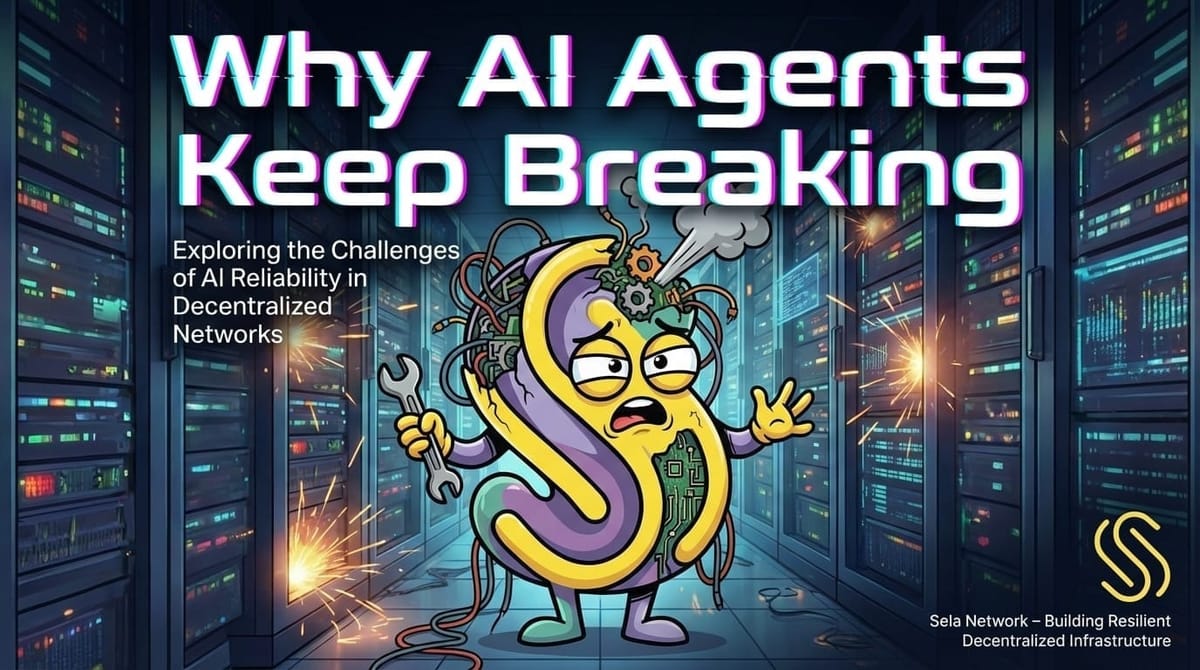
Why AI Agents Keep Breaking
It’s Not the Model — It’s the Execution Environment
If you’ve ever tried to connect an AI agent to the real web, this probably feels familiar.
The agent works fine in isolation.
It reasons well, plans correctly, and produces sensible outputs in testing.
But the moment you wire it into a live website, things start to fall apart.
Something that worked yesterday suddenly fails today.
A small UI change breaks the entire flow.
A login step hangs.
A selector stops matching.
Retries pile up.
Logs stop making sense.
At that point, the instinctive reaction is usually the same:
Is the model not good enough yet?
Do we need better prompting?
More guardrails? More retries?
In practice, the problem is almost never the model.
AI agents don’t break because they can’t think.
They break because they can’t execute.
Modern AI Is Already Good at Decision-Making
Today’s AI agents are not simple scripts.
They can interpret goals, compare options, decompose tasks, and plan multi-step workflows.
Ask an agent to:
- Evaluate multiple vendors
- Compare pricing and constraints
- Choose an optimal path
- Adapt when conditions change
And it generally does so competently.
Decision-making is no longer the bottleneck.
The failure almost always happens after the decision has been made — when the agent tries to act on the web.
The Moment Agents Touch the Real Web
The web was never designed for machines.
It assumes a human user:
- Looking at a screen
- Clicking elements
- Typing into fields
- Solving small ambiguities along the way
When an AI agent enters this environment, it immediately encounters friction:
- Bot detection and automation defenses
- CAPTCHA and secondary verification flows
- Constantly changing DOM structures
- JavaScript-heavy SPAs with hidden state
- Fragile session, cookie, and fingerprint logic
From a developer’s perspective, these issues feel like endless maintenance.
From the agent’s perspective, they’re hard stop conditions.
The agent doesn’t “make a bad decision.”
It simply cannot proceed.
This Isn’t a Bug — It’s a Structural Mismatch
Most teams treat these failures as implementation details.
They patch selectors.
Add retries.
Handle edge cases.
Ship hotfixes when something breaks.
But this approach never converges.
Why?
Because the web itself is dynamic, defensive, and actively hostile to automation.
This isn’t a code quality problem.
It’s a mismatch between who the web was built for and who is now expected to operate it.
AI agents are being asked to work in an environment that was never designed for them.
Why “Just Use APIs” Isn’t a Real Answer
At this point, someone usually suggests APIs.
APIs are great — when they exist.
But developers know the reality:
- Many critical systems expose no APIs
- Internal dashboards and admin panels are UI-only
- Legacy tools still run entire workflows in the browser
- Real human labor still happens in web interfaces
If AI agents are meant to replace or assist human work, they need to operate where humans already work.
That place is still the browser.
Execution Is an Infrastructure Problem, Not a Feature
Here’s the shift that matters.
Execution is not a feature you bolt on.
It’s not something you solve with a clever script.
Execution is infrastructure.
For an AI agent to operate reliably, it needs:
- A real browser environment
- Stable rendering and interaction behavior
- Persistent session and state handling
- Failure detection and recovery
- A consistent definition of “task completion”
Trying to solve this at the application layer leads to fragile systems and constant breakage.
What’s missing is a dedicated execution layer.
How Sela Network Approaches the Problem
Sela Network doesn’t try to make AI models smarter.
We start from a different assumption:
AI already knows what to do.
What it lacks is a reliable way to do it.
Sela provides an execution layer for AI agents — a system designed specifically to translate agent intent into real, completed web actions.
The separation is intentional:
- The agent handles reasoning and decisions
- Sela handles execution in the real web
This keeps systems simpler, more reliable, and easier to maintain.
Why a Decentralized Browser Network Matters
Most web automation stacks run from centralized infrastructure.
That creates obvious weaknesses:
- Predictable IP patterns
- Regional concentration
- Single points of failure
- Easy detection and blocking
Sela operates a decentralized network of browser nodes distributed across regions and environments.
This isn’t about evasion.
It’s about realism.
The web is global and heterogeneous.
Execution environments should be too.
When AI operates in conditions that resemble real user behavior, stability improves dramatically.
Completion, Not Access, as the Success Metric
Traditional automation tools often define success as “page loaded” or “request succeeded.”
That’s not how real work functions.
What matters is:
- Did the flow finish?
- Was the intended state change applied?
- Is there a verifiable result?
Sela is designed around task completion, not mere access.
This distinction becomes critical once agents are part of production systems.
Verifiable Execution: Proof of Action
As AI agents move into real operational roles, trust becomes an issue.
It’s no longer enough for an agent to say “done.”
Sela records execution paths:
- Requests
- Page transitions
- UI interactions
This creates a Proof of Action — an auditable record that the work was actually performed.
For developers, this means fewer black boxes and more confidence in agent behavior.
The Question Developers Should Be Asking Now
The key question is no longer:
How smart is the model?
It’s:
How reliable is execution?
As model capabilities converge, execution infrastructure becomes the real differentiator.
The next generation of AI systems won’t be judged by how impressive their demos are — but by whether they can operate continuously, reliably, and at scale.
Execution Infrastructure Is No Longer Optional
Cloud computing won by abstracting servers.
Payments scaled by abstracting financial complexity.
The AI agent era will be defined by who abstracts execution.
Sela Network is building that layer.
The web was built for humans.
If AI agents are going to work there too, the infrastructure has to change.
That change starts with execution.