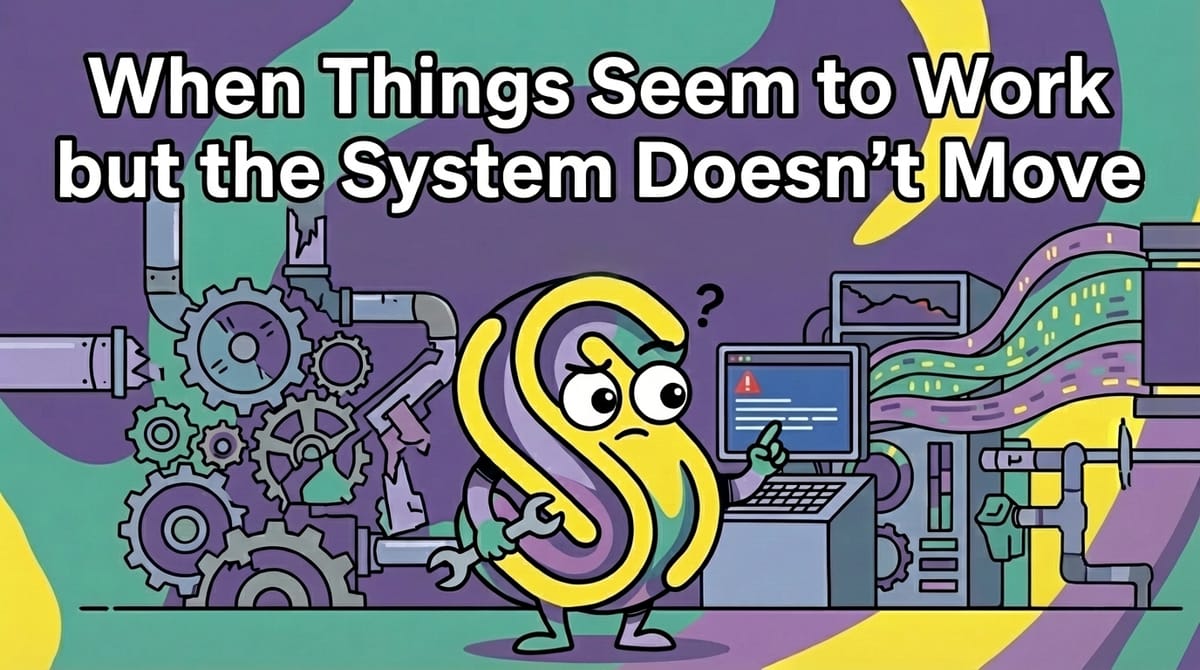
When Things Seem to Work but the System Doesn’t Move
Notes from real environments where agents behave correctly and still fail
There’s a specific point where AI agents stop feeling impressive and start feeling confusing. It usually happens after the demo phase, once the agent is connected to something real. Not a mocked endpoint or a sandbox, but an actual website, an internal admin panel, or a production system that people use every day.
Up to that moment, everything looks fine.
The reasoning is coherent. The task breakdown is logical. Each step appears to follow naturally from the last.
Then you check the system itself and realize nothing actually changed.
There is no crash, no clear rejection, no obvious signal that execution failed. The agent continues as if progress has been made, while the external state remains exactly the same. This mismatch between perceived execution and real-world impact is subtle, but it shows up again and again once agents leave controlled environments.
I kept thinking about this gap while reading two recent essays that approach the problem from very different directions. One focuses on infrastructure under pressure from agent workloads. The other looks at how the web itself is starting to be consumed by agents rather than people.
They don’t overlap in argument, but they describe the same shift from opposite sides.
What follows isn’t a summary of either piece. It’s closer to a set of observations that emerge once you’ve watched agents “do everything right” and still fail to change anything.
Human behavior is still baked into most systems
Most software still encodes expectations about how humans behave, even when no one explicitly states those assumptions.
Users click, then wait.They don’t generate bursts of hundreds of actions in milliseconds.They notice when something feels wrong and adjust.
These assumptions appear everywhere: rate limits, session expiration rules, retry logic, UI flow design. All of it reflects an environment where attention, hesitation, and delay are normal.
Agents don’t introduce those pauses.
When given a goal, an agent immediately decomposes it, runs subtasks in parallel, retries quickly, and proceeds based on whether it received a response, not whether a human would feel confident the action succeeded.
From the system’s point of view, this behavior doesn’t look like normal usage. It doesn’t map cleanly to the patterns the software was designed to handle.
Failure becomes harder to detect, not easier
One reason this problem persists is that agent failures often don’t surface as failures at all.
A human notices when a form submission doesn’t stick.An agent only notices whether a response was returned.
Interfaces may update, notifications may appear briefly, and logs may show activity. At the same time, the backend can reject or ignore the action without making that rejection explicit.
Once that happens, the agent proceeds under the assumption that the step succeeded. Everything downstream is now built on an incorrect premise, even though nothing visibly “broke.”
This is why debugging agent systems is often frustrating. You see motion everywhere, but outcomes don’t align with expectations.
More capacity doesn’t address the real issue
When teams run into this behavior, the first response is usually to scale.
Increase throughput. Raise concurrency limits. Add more resources.
But agent workloads don’t just add volume. They change execution patterns.
Human traffic has natural boundaries. Agent traffic expands recursively. A single instruction can trigger hundreds or thousands of operations, many of which interact with shared state or depend on intermediate outcomes.
At that point, raw compute is rarely the constraint. The harder problem is coordination.
Which operation actually mattered? Which update should be treated as authoritative? How should the system react when part of a task fails without signaling it clearly?
These questions sit in the control plane, not the data plane, and most existing systems were never designed to answer them under sustained agent-driven concurrency.
This is why agent-native infrastructure isn’t about speed. It’s about assuming contention and parallelism as normal operating conditions.
The web is being consumed differently now
While infrastructure struggles underneath, the surface layer is changing too.
For a long time, the web has been optimized around human attention. Headlines, visual hierarchy, summaries, and layout all existed to accommodate skimming and distraction.
Agents don’t skim.
They process entire documents, regardless of placement or presentation. Information that a human might overlook remains equally accessible to an agent.
This alters what effective content looks like. It also changes how software interfaces are used. Dashboards no longer need to be watched continuously. Logs don’t need to be explored manually. Agents can read, interpret, and summarize without relying on visual cues.
The web still serves people, but it now has an additional audience that interacts with it very differently.
Execution is where things break down
When agent-readable content meets agent-driven infrastructure, execution becomes the weak point.
Agents can decide what to do and identify where to do it. Actually making the change stick is harder.
The web isn’t a clean API. It involves sessions, cookies, timing constraints, regional behavior, and layers of automation detection. An action that appears successful at the interface level may not persist at the system level.
Determining whether something truly happened becomes non-trivial once workflows grow complex.
That’s why execution can’t be treated as an implementation detail. It’s foundational to whether autonomy is real or only apparent.
The part of the stack that resists clean abstraction
Execution is awkward to work with. It’s inconsistent, environment-specific, and difficult to generalize. It also doesn’t make for clean demos.
Still, this is where agent systems succeed or fail.
Retries don’t solve silent rejections. Improved reasoning doesn’t fix expired sessions. Better planning doesn’t help if state changes never persist.
Eventually, agents need execution environments that reflect how the real web behaves, not how we wish it behaved.
Why Sela Network concentrates here
This is the gap Sela Network is designed to address.
Rather than focusing on reasoning quality or orchestration alone, the emphasis is on execution as infrastructure. The premise is that agents need environments that resemble real user conditions if they’re expected to operate reliably.
That includes browser-based execution that mirrors real usage patterns, sessions that persist across longer workflows, geographic and behavioral context that matches reality, and clear signals about whether an action actually succeeded.
The goal isn’t to work around the web, but to operate within it in a way that is observable and stable.
Without this layer, agent autonomy remains fragile.
Reliability matters more than sophistication
Once agents are deployed in production environments, a consistent pattern appears.
A moderately capable agent that executes reliably is often more valuable than a highly sophisticated agent that fails silently.
In enterprise and infrastructure-heavy contexts, confidence in outcomes matters more than elegance in reasoning. Knowing that something actually changed is more important than knowing how cleverly it was decided.
A shift already underway
None of this happens all at once.
People will continue to use apps directly.Interfaces will continue to matter.Legacy systems won’t disappear overnight.
But the center of gravity is moving. Agents are increasingly acting as intermediaries, infrastructure is being tested in unfamiliar ways, and execution can no longer be glossed over.
The question isn’t whether agents will interact with the web. It’s whether the systems behind the web are prepared for behavior that no longer resembles human use.
Closing
What makes this transition easy to overlook is how quietly it unfolds. There’s no dramatic failure, just a growing number of moments where something should have worked and didn’t.
Seen from a distance, the pattern becomes clear.
Systems built around human behavior are being stretched by agent behavior. Interfaces designed to be glanced at are being read end to end. Assumed execution is being replaced by the need for verification.
This isn’t a distant scenario. It’s already happening, one subtle mismatch at a time.