The Entropic Fracture: Why Authority Fails Where Reliability Holds
The Quiet Side-Channel
This isn't a continuation. Not really. Most of what I’ve written before follows a certain trajectory, a push toward a finality that feels good on paper. But this piece refuses that. It’s a side chapter, a moment where the gears grind because they’ve hit something hard and unyielding. It’s an observation from a different distance, and in the world of data and systems, distance is everything.
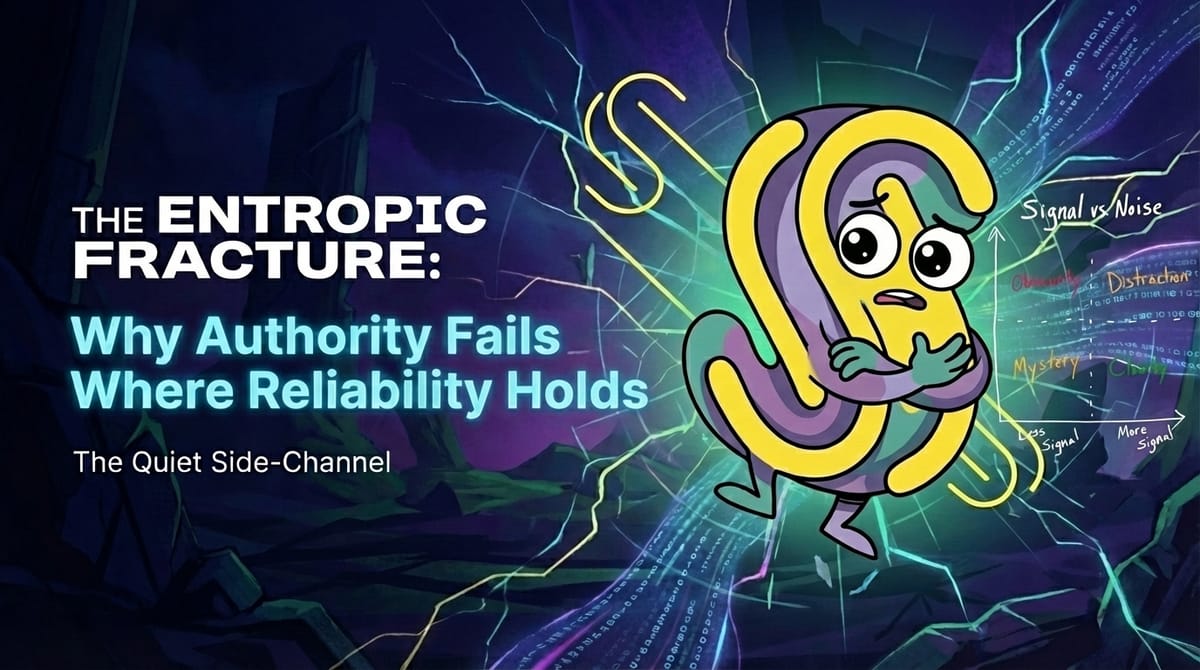
We usually sprint toward "clarity." We think that if we just aggregate enough signals, the noise will eventually surrender. But it doesn’t. This essay is a pause. It’s an attempt to look at the parts we usually skip—the messy, entropic reality of how we actually make decisions when the screens are glowing and the metrics are screaming in opposite directions. I’m not here to win an argument. I’m here to figure out why, despite all our tools, the same arguments keep coming back to haunt us.
The Great Divergence
In a simple world, authority and reliability are the same thing. You trust the doctor because they have the degree; you trust the bridge because the engineer signed the permit. This overlap is efficient. It’s a social shortcut. But the moment you introduce massive, automated data systems, that marriage hits the rocks.
Authority and reliability start to drift. You see it everywhere: a system that looks incredibly "authoritative" crisp UI, 4decimal place precision, complex terminology but behaves like a random number generator. And then you have the "reliable" systems, which are often ugly, invisible, and silent until something breaks.
This divergence happens because of a fundamental misunderstanding of what information does to a room. We assume more information equals more certainty. That is the great lie of the digital age. In reality, more information often just creates more ways to be wrong.
The Physics of Information Entropy
Let’s talk about entropy. Not the "messy bedroom" version, but the real version: the measure of possible states. In a high-entropy system, there are a million different ways the pieces can be arranged. Predicting which arrangement you're looking at becomes a nightmare.
Data systems are thermodynamic. As you pour more data into a decision-making process without adding structural "chilled" constraints, the entropy rises. You aren't getting closer to the truth; you are just multiplying the number of plausible hallucinations.
Think about a typical board meeting. There is a dashboard. The dashboard shows a 5% drop in user engagement. One person sees a seasonal trend. Another sees a UI failure. A third sees a competitor’s move. The data hasn't provided an answer; it has provided a terrain for a fight. The data isn't the solution; it's the fuel for the entropy. At a certain point, data stops acting like a flashlight and starts acting like a fog. You’re no longer deciding what is true. You’re navigating the ghosts of what might be true.
Authority as a Psychological Band-Aid
Here is the dark part: high entropy makes people crave authority. When the world is confusing, the person who stands up and says "I know exactly what this means" becomes a savior. It doesn't matter if they're actually right. What matters is that they are reducing the cognitive load for everyone else.
Authority in these systems acts as a "complexity sponge." It absorbs all that messy entropy and reflects back a smooth, confident surface. This is a trap. Authority simplifies by hiding the "how" and the "why." It demands that you stop looking at the gears and just trust the clock face. Reliability, on the other hand, is the opposite. Reliability doesn't hide the complexity; it exposes it and shows you exactly how it’s being managed.
The difference between an authoritative system and a reliable one is the difference between a magician and a mechanic. The magician hides the trick to create an illusion of power. The mechanic shows you the grease and the torque because that’s the only way to prove the machine won't explode.
The Invisible Weight of Reliability
Reliability is boring. It’s unspectacular. You can’t put "we were consistently mediocre but predictable" in a marketing deck. Reliability is a lagging indicator, it’s the stuff that’s left over after a thousand boring Tuesday mornings where nothing went wrong.
It’s about "locating" uncertainty. A reliable system doesn't lie to you and say "everything is 100% fine." It says, "We know X, we suspect Y, and we are totally blind regarding Z." It offers boundaries. It gives you a map that actually has "Here be Dragons" written on it, instead of a fake map that pretends the whole world is a paved parking lot.
Trust isn't built by a charismatic leader or a beautiful visualization. It’s built by the boring, repetitive accumulation of evidence. It’s built when a system fails, because everything fails and instead of a PR spin, you get a transparent autopsy.
Entropy Downstream: The Human Problem
We spend billions on "clean data." We act as if the entropy is a bug in the database. But the worst entropy is always downstream. It’s in the way we interpret things.
You can have the cleanest data in the world, but if the people using it have shifting goals, unstated biases, or a fear of being fired, that data becomes a weapon or a shield, but never a tool. This is why "data-driven" companies are often the most chaotic. They have plenty of "what" but zero "why."
When interpretation is unconstrained, entropy doesn't just go away; it moves. It moves from the server to the human brain, where it’s much harder to debug. To fix this, you don't need more data. You need more constraints. You need to limit the "freedom" of interpretation. That sounds oppressive, but in information theory, constraint is the only thing that creates meaning.
Accuracy is a Number, Reliability is a Contract
There’s a massive gap between being accurate and being reliable. Accuracy is about the moment. It’s a snapshot. "The temperature is 72 degrees." That’s accurate. Reliability is about the contract. "Can I trust this thermometer when it’s 40 below? Does it tell me when its battery is dying? Who calibrated it?"
Accuracy belongs to the numbers, which are cold and indifferent. Reliability belongs to the system, which is social and ethical. A reliable system defines its own limits. It tells you its assumptions. It tells you what it excluded. By doing this, it actually reduces its own power in the short term to ensure its survival in the long term.
The Ethical Act of Entropy Reduction
This leads to something we rarely talk about: reducing entropy is a moral choice. High-entropy systems allow people to hide. "The algorithm did it." "The data suggested it." These are the phrases of people living in a fog.
When you reduce entropy - when you make the decision criteria explicit and the assumptions traceable - you are forcing responsibility back onto human shoulders. It’s uncomfortable. It removes the "plausible deniability" that many leaders use as a safety net. But it is the only way to build a system that actually serves people instead of just processing them.
Recovery vs. Speed
The cult of "speed" is the enemy of reliability. Speed is a marker of authority - "Look how fast we can pivot!" Reliability is marked by recovery.
How quickly does the error show up? How transparent is the fix? Does the mistake happen again? A reliable system isn't one that never breaks. It’s one that breaks in ways that make sense. It’s a system where the failure mode is as well-designed as the success mode. In a high-entropy world, you can't stop the cascade, but you can build firewalls.
Closing: The Work of Exclusion
So, why write this side chapter? Because we are obsessed with "more." More features, more data, more authority. But in an age of peak information, the only way forward is "less."
We need to exclude the noise. We need to narrow the interpretations. We need to stop looking for a "source of truth" and start looking for a "source of reliability."
Authority is a performance. It’s asserted, usually loudly. Reliability is a record. It’s recorded, usually quietly. In the end, the systems that survive won't be the ones that had the most data or the loudest voices. They will be the ones that were honest about their own entropy. They will be the ones that traded the illusion of certainty for the reality of a bounded, predictable, and ultimately human record.