Somewhere Between Action and Responsibility
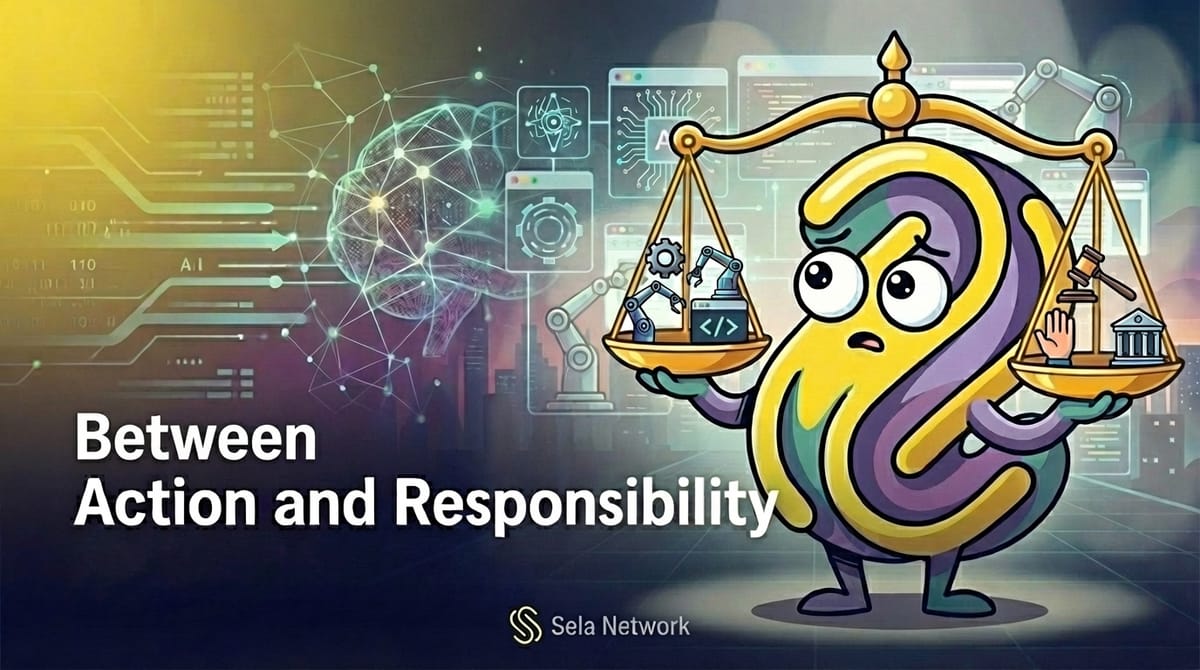
Why the Web Still Struggles With AI Agents
Conversations about AI agents tend to accelerate very quickly. Almost too quickly to notice what gets left behind.
The early part is always the same. People talk about capability. About how far autonomy can go. About how many steps an agent can chain together without human input.
There is usually a demo involved. A screen recording. A confident voice explaining how the agent logged in, navigated an interface, and completed a task that used to take hours.
Everyone nods. The system works.
And then, almost imperceptibly, the conversation moves on.
That is the moment I keep thinking about.
Not the success itself, but what follows it. The quiet space where no one quite asks what that success actually means.
AI Agents Are No Longer Just Thinking Systems
For a long time, software stayed safely on one side of a boundary. It processed information. It calculated. It suggested.
Humans acted.
AI agents blur that separation.
They do not stop at recommendation. They move through authenticated websites. They fill in forms. They retrieve restricted data. They submit requests that alter real systems.
These are not abstract operations. They are the same actions a human would perform, just faster and without hesitation.
From a distance, this feels like progress. Delegation is efficient. Letting machines handle repetitive execution seems inevitable.
But delegation has always depended on something subtle: the ability to clearly point to who is responsible.
That clarity is starting to erode.
The Web Was Designed Around a Clear Actor
Most of the modern web still rests on an assumption that rarely gets questioned.
A human authenticates. A human performs an action. A human can be held accountable.
Authentication systems, access controls, audit trails, terms of service all of them depend on this model.
Even earlier automation fit within it. Scripts ran on servers owned by organizations. Bots were external and easy to classify.
AI agents are neither.
They operate inside the same interfaces as humans. They use credentials that belong to real people. They make decisions without asking permission at every step.
They are not legal subjects. But they are no longer simple tools either.
They exist in between.
And “in between” is where systems tend to break down.
Legal Risk Does Not Announce Itself Loudly
From a legal and compliance perspective, ambiguity is rarely neutral. It is potential risk that has not yet been triggered.
Most legal frameworks are built around attribution. Someone must be identifiable as the actor. Authority must be traceable. Intent must be explainable after the fact.
Agent-based execution fragments these ideas.
The user provides intent but does not perform the action. The system performs the action but does not originate intent. The agent interprets, adapts, and executes across multiple steps.
Responsibility thins across that chain.
Nothing fails immediately. Which is precisely why the problem is easy to ignore.
But the absence of failure is not proof of safety. It is often just a lack of scrutiny.
Why AI Agents So Often Stop at the Demo Stage
In practice, this tension shows up in quiet, familiar ways.
Many teams already have AI agents that function extremely well. They gather market data. They generate research reports. They automate sales intelligence and internal workflows.
The technical part is not the issue.
The issue appears when someone asks whether the system is ready for production.
As soon as agents require authenticated web access, the questions begin:
- Are we acting as the user, or as a service?
- Is this behavior explicitly permitted, or merely tolerated?
- If an account is flagged or suspended, who absorbs that cost?
- How would we explain this execution path to a regulator or a platform?
No one says “this is illegal.” But no one says “this is clearly safe” either.
That hesitation is enough.
The agent stays internal. Or becomes a proof of concept. Or quietly gets shelved.
Not because it failed but because no one wanted to own the consequences of its success.
The Problem Is Not Malice, but Misalignment
It would be easy to frame this as bad actors pushing boundaries. But that is not what most teams are doing.
Most teams are simply trying to build useful products.
The problem is structural. The web still expects a human actor.AI agents behave like delegated executors.
Those two ideas do not align cleanly.
Workarounds appear. Temporary fixes. Small compromises that seem harmless in isolation.
Over time, those compromises accumulate. And with them, uncertainty grows.
Sela Network Begins With This Exact Tension
Sela does not start by promising smarter agents or more autonomy. It starts by acknowledging the discomfort most teams try to work around.
How do AI agents execute actions on the web without dissolving ownership, consent, and accountability?
Sela does not provide data. It does not resell access. It does not bypass authentication or platform controls.
Instead, it operates strictly within what the user already has the right to do.
The agent runs on infrastructure owned by the user. It accesses only authenticated environments the user can access. It executes only actions explicitly approved by the user.
The agent may act. But the actor remains identifiable.
This distinction is not cosmetic. It determines whether responsibility survives delegation.
Execution Is Not the Same as Automation
Most automation tools are designed to reduce friction. They hide complexity. They make systems feel effortless.
Sela takes a different approach.
It keeps execution legible.
Rather than controlling agents, it makes control provable. Rather than abstracting responsibility away, it preserves it.
Every action can be reconstructed:
- who approved it
- under what authority
- within which environment
This is not surveillance. It is continuity.
Without continuity, automation becomes fragile — not technically, but institutionally.
Why Accountability Matters Before Scale
AI agents are rapidly moving from experiments into production systems.
They will submit applications, update records, negotiate terms, coordinate workflows. They will touch platforms that were never designed for non-human actors.
The web still asks a simple binary question: Are you human?
Agents answer neither yes nor no.
Until that mismatch is addressed, every agent operating on the web carries hidden risk.
Some teams will accept that risk to move faster. Others will slow down, or decide not to ship at all.
Both responses are understandable.
But only one of them remains defensible once scrutiny arrives.
Accountability Cannot Be Retrofitted
Responsibility is not a feature you add later. Once execution detaches from ownership, restoring that link is expensive and often impossible.
Logs alone are insufficient. Events alone are not evidence.
What matters is being able to explain an action coherently after time has passed.
Who initiated it. Who authorized it. Who is accountable for its consequences.
This layer is often ignored because it is not exciting. But it is the layer that determines whether systems survive contact with reality.
This Problem Will Grow Quietly
There will not be a single dramatic failure that forces this issue overnight.
Instead, it will show up as friction. More features delayed. More agents stuck behind internal flags. More demos that never become products.
The web will continue to assume humans. Agents will continue to act anyway.
The gap between the two will widen.
Why Sela Exists
Sela is built for teams that want AI agents in production without sacrificing accountability.
Not because caution is virtuous. But because responsibility is unavoidable. This is not the most visible layer of the AI stack. It does not promise magic or virality.But when questions arise - legal, operational, or ethical - it becomes the layer that matters most. At some point, someone will ask a very simple question:
Who did this?
When that moment comes, having a clear answer will matter more than how impressive the agent once looked. That is the execution layer Sela is building. Quietly. Deliberately. Before responsibility disappears entirely.