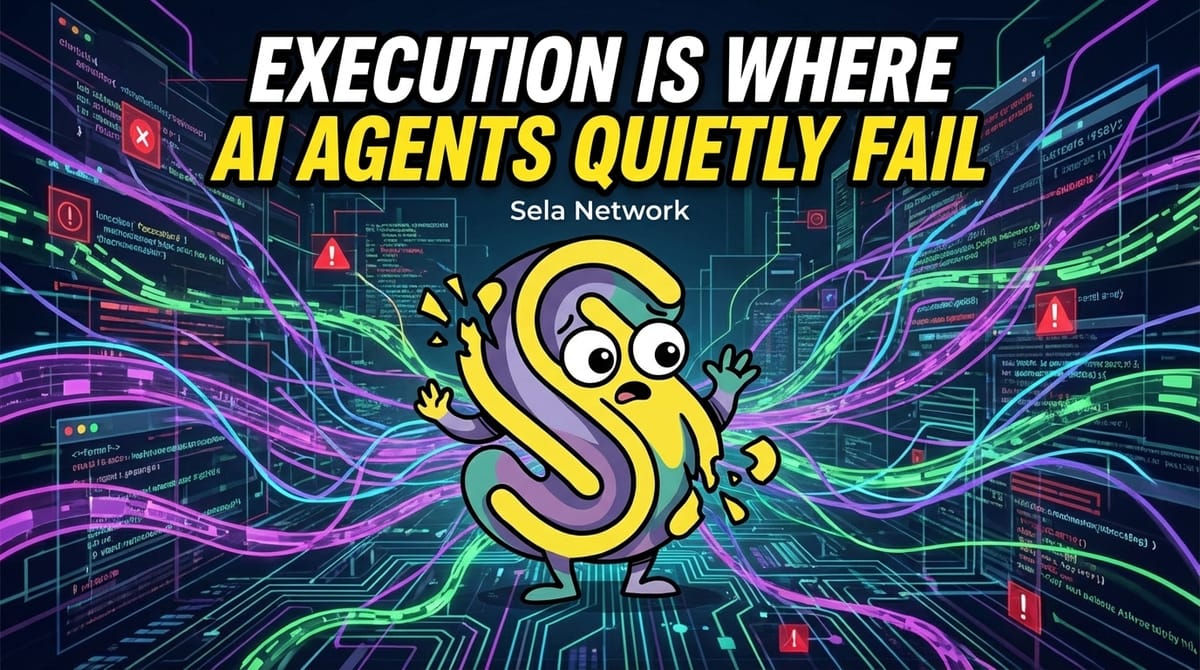
Execution Is Where AI Agents Quietly Fail
What We Keep Seeing in the Real Web
If you have spent any real time trying to run AI agents on live websites, some patterns start to repeat.
At first, things look fine.
The agent responds clearly.
The plan feels reasonable.
Early tests pass without much effort.
Then the agent is connected to an actual production site.
Nothing dramatic happens.
There is no obvious error.
Things just stop moving.
A login takes longer than expected.
A page loads, but the next step never triggers.
The button is there, but the agent hesitates.
Logs fill up with information that does not explain the failure.
Most teams have seen this moment.
Someone says the model might be confused.
Someone suggests adding another retry.
Someone proposes adjusting the prompt.
Those changes sometimes help.
Usually, they do not.
Over time, you start to notice something else.
The agent usually knows what it is trying to do.
The problem is that the web does not let it finish.
What execution failures actually look like
Execution failures are rarely clean.
They do not show up as a single broken function.
They appear as friction.
Small delays.
Unexpected popups.
Subtle UI shifts.
Sessions that expire a little earlier than expected.
Humans handle these moments without thinking.
They wait.
They scroll.
They notice when something feels different.
Agents do not have that instinct.
From the agent’s perspective, these are not inconveniences.
They are stop signs.
We have watched agents get stuck on pages that technically loaded.
We have seen flows break because a page rendered one second slower than usual.
We have seen systems work perfectly in the morning and fail quietly by evening.
None of this shows up in demos.
Why this keeps surprising teams
Part of the reason execution issues persist is that they feel secondary.
Decision making sounds important.
Execution sounds mechanical.
So teams focus on the agent’s reasoning and treat execution as an implementation detail.
Until it starts consuming most of the engineering time.
Selectors get patched.
Workarounds pile up.
The agent logic slowly fills with web specific exceptions.
At some point, it becomes hard to tell where reasoning ends and execution begins.
This is usually when teams realize the problem is not local.
The web is not stable.
It changes constantly.
It defends itself.
And it was never designed for software to behave like a user.
Seeing execution as its own layer
This is the shift that changes how the problem is approached.
Execution is not something an agent should manage directly.
It behaves more like infrastructure.
It has its own concerns.
Its own failure modes.
Its own scaling problems.
Execution involves real browser environments.
It involves rendering that settles before interaction.
It involves session continuity, cookies, fingerprints, and timing.
Trying to solve all of this inside each application creates fragile systems.
We have seen this pattern repeat across teams and use cases.
Where Sela Network comes from
Sela Network did not start from the question of how to make agents smarter.
It started from watching agents fail in the same places, over and over.
Not because they made bad decisions.
But because execution quietly collapsed underneath them.
The assumption behind Sela is simple.
Agents already know what to do.
They need a reliable way to do it on the real web.
Sela focuses on execution as a dedicated layer.
The agent handles intent and decisions.
Sela handles the web environment where those decisions are carried out.
This separation removes a large amount of hidden complexity from agent logic.
Why distribution matters in practice
One thing that becomes obvious when observing execution failures is how sensitive they are to environment.
Centralized automation behaves predictably.
Predictable behavior gets flagged.
Real users are not predictable.
They are spread across regions.
They use different devices.
Their connections vary.
Sela runs execution through a distributed network of real browser nodes.
Not to bypass the web, but to resemble it.
When execution environments look ordinary, flows tend to break less often.
Completion is the only signal that matters
Another observation that keeps coming up is how success is measured.
A page loading does not mean work is done.
A successful request does not mean the task finished.
What matters is whether the intended change actually happened.
Did the form submit
Did the state update
Can the result be verified later
Sela treats completion as the primary signal, not access.
This sounds subtle, but it changes system behavior significantly.
Trust grows from visibility
As agents take on more responsibility, trust becomes practical.
Teams want to know what actually happened when something goes wrong.
Execution should leave a trail.
What was accessed.
What was clicked.
What changed.
This is not about dashboards or presentation.
It is about being able to answer simple questions after the fact.
What keeps coming back to execution
Across different teams, different products, and different agent designs, the same pattern appears.
Models improve quickly.
Reasoning quality converges.
What separates systems is not intelligence.
It is whether execution holds up after the initial demo.
Execution is where systems quietly succeed or fail.
Sela Network is being built around that observation.
The web was shaped around humans.
If AI agents are going to operate there at scale, execution has to be treated as its own system.
That is the layer Sela is focused on.