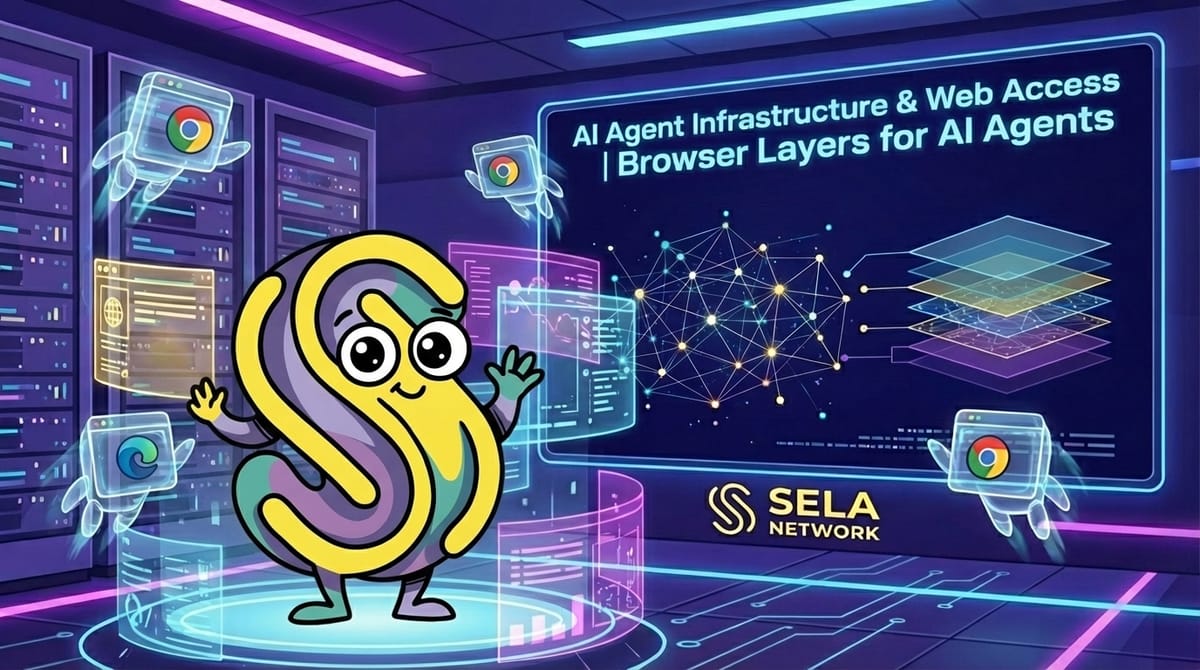
AI Agent Infrastructure & Web Access | Browser Layers for AI Agents
The Agent Economy Has a Plumbing Problem: Why We Are Rebuilding the Web for AI
Let’s be honest about the last thirty years of tech history. From the clunky desktops of the 90s to the sleek cloud architectures of today, every single line of code, every interface, and every protocol had one specific master: the human user.
We built browsers to render visuals for human retinas. We designed UX flows to guide human fingers. We erected CAPTCHAs and firewalls specifically to demand proof of humanity. The World Wide Web, in its current form, is essentially a massive graphical user interface (GUI) designed to help people find information and buy things.
But the board is being flipped. We are currently witnessing the most significant pivot since the invention of the internet itself. Technology is no longer just a tool we pick up and put down. It is becoming a laborer.
We call them AI Agents. They are the new workforce. And right now, they are facing a crisis that no amount of model training can solve.
"The worker has evolved, but the workplace is hostile."
The "Brain in a Jar" Paradox
If you look at the current state of Large Language Models (LLMs), it’s easy to get swept up in the hype. They are brilliant. They can pass the bar exam, write poetry, and debug complex Python scripts. You can ask an agent to "plan a travel itinerary" or "monitor supply chain risks," and its reasoning capabilities are practically indistinguishable from a skilled human assistant.
[Image Idea: An illustration showing a glowing AI brain connected to a computer, but the cables are cut or blocked by a brick wall labeled 'CAPTCHA' or '403 Forbidden'.]
But here is the dirty secret that most demo videos don’t show you: The moment that brilliant AI tries to step out of its chat interface and do actual work on the real web, it falls apart.
It’s the "Brain in a Jar" paradox. The AI has the intellect of a genius, but it has no hands.
When an agent tries to access a booking site, it gets blocked by a security challenge designed to stop bots. When it tries to read a pricing table, a sudden change in the website’s DOM structure breaks its parser. When it tries to navigate a complex single-page application (SPA), it gets lost in a maze of JavaScript that it cannot render.
The industry’s response to this has been lazy. We’ve blamed the models for hallucinating. We’ve blamed the websites for being "anti-bot." But that misses the point entirely. This isn’t a software bug. This is an infrastructure gap.
We are trying to force a digital workforce to commute on roads built for analog humans. It’s like putting an F1 car on a dirt track and wondering why it can’t hit top speed. If we want the Agent Economy to be more than just a buzzword, we have to stop building better cars and start paving the road.
Sela Network exists to pave that road.
Moving From "Scraping" to "Execution"
For the past decade, if a machine visited a website, it was usually for one reason: to steal data. We called it web scraping. The goal was passive—get the text, parse the HTML, and leave.
But the era of the AI Agent demands something different. Agents don’t just want to read; they need to act.
There is a massive difference between these two commands:
- "Show me the price of this flight."
- "Log in to my account, select the window seat, apply my loyalty points, and execute the payment."
The first is data collection. The second is Task Execution.
The current infrastructure of proxies and headless browsers was built for the first era. They are brittle, suspicious, and easily detected. They were designed for observers, not participants.
Sela is building the Execution Layer. We are not just helping AI connect to a server; we are providing the stable environment required for it to behave like a sophisticated user. We handle the chaotic reality of the modern web—the dynamic rendering, the fingerprinting, the cookie management—so the AI can focus on the decision-making logic.
We don’t sell "access." Access is cheap. We sell completion.
We sell the guarantee that when your agent sets out to do a job, it actually gets done.
The Developer’s Nightmare: Maintenance Hell
Let’s look at this from the trenches. If you are a developer building an AI application today, you know the pain I’m talking about.
You write a script to interact with a popular e-commerce site. It works perfectly on Tuesday. On Wednesday, the site pushes a minor UI update—maybe they changed a div class or updated a React component. Suddenly, your agent breaks. It crashes. It hallucinates because it can’t find the "Buy" button anymore.
[Image Idea: A split screen. Left side: A clean Python script. Right side: A chaotic mess of 404 errors and broken HTML tags.]
You aren't spending your time improving your AI model. You are spending 80% of your engineering cycles playing a game of whack-a-mole with broken web integrations. This is "Maintenance Hell," and it is the single biggest bottleneck killing AI startups today.
Sela’s vision is to abstract this entire mess away.
Think of how Stripe abstracted the nightmare of banking protocols into a few clean lines of code. Or how AWS abstracted the complexity of racking servers. Sela abstracts the chaos of the web into a reliable Function Space.
We view the web not as a collection of visual pages, but as a library of executable functions. The developer sends the intent; Sela handles the navigation, the rendering, and the interaction. By decoupling the "logic" from the "mechanics," we liberate developers to build smarter agents rather than fixing broken scrapers.
The Crisis of Trust: Proof of Action
There is another looming problem that few people are talking about yet. As we unleash billions of autonomous agents into the wild, how do we verify what they are doing?
Imagine an AI agent responsible for financial transactions or supply chain orders. It comes back and says, "Task Complete."
Great. But did it?
Did it actually visit the vendor’s site? Did it see the correct price, or did it hallucinate a number because the page didn't load correctly? In a B2B context, "trust me, I’m an AI" is not an acceptable audit trail.
This is where the concept of Proof of Action (PoA) becomes non-negotiable. The Agent Economy needs a currency of trust.
Sela provides this by cryptographically verifying the agent’s journey. We record the "labor"—the HTTP requests, the DOM interactions, the navigation path—and provide an immutable proof that the work was performed.
This transforms AI labor from a black box into a transparent, verifiable asset. It’s the difference between sending an intern to run an errand and getting a stamped receipt, versus the intern just coming back and saying "it's done."
The Decentralized Advantage
Finally, we have to talk about resilience.
The centralized web is fragile. A single IP ban, a regional geoblock, or a server outage can paralyze a centralized AI fleet. If your agents are running from a single data center in Virginia, they are sitting ducks for bot detection systems.
Sela’s architecture is fundamentally different. By utilizing a decentralized network of nodes, we create an execution environment that is geographically diverse and resistant to censorship.
This isn't just about bypassing bans; it's about mirroring organic human behavior. Real users are everywhere, on all kinds of devices, with all kinds of connection speeds. To integrate seamlessly with the web, AI needs to inhabit that same diverse ecosystem.
Conclusion: Infrastructure is Destiny
We are standing at the edge of a new internet. The AI model wars are largely over; the models are good enough. The parameters are commoditized.
The winners of the next decade won’t be the companies with the smartest chatbots. The winners will be the ones who can make those chatbots actually work in the real world.
We are moving from a "Read-Only" relationship with AI to a "Read-Write" relationship. We are handing over the keys to our digital lives and asking these agents to drive. But they can’t drive if the roads are broken.
Sela Network is not just a tool provider. We are the heavy civil engineers of this new era. We are digging the tunnels and laying the asphalt for the digital workforce.
The web was built for us. It’s time we rebuilt it for them.
If you want to see how AI Agent Infrastructure, Browser Layers, and AI Agent Web Access work in practice, you can explore Sela Network directly.